


What is Femicore?
Femicore is a dietary supplement sold in capsule form for women who deal with bladder urgency, frequent trips to the bathroom, or occasional leaks. It is described as a daily supplement that combines specialized probiotic strains with plant-based ingredients to support bladder health and microbiome balance. It is sold only through its own website, not in stores or on major marketplaces.
That last point matters more than it sounds, and it comes up again in the section on fake sites below.
Femicore is a supplement, not a drug. Supplements in the United States aren’t approved by the FDA before they go on sale, and brands may not claim to diagnose, treat, or cure a disease. So when a page tells you a supplement “fixes” a bladder problem, treat it as marketing language, not a medical finding.
What’s in it
Reviewers disagree about the exact formula, and that is a warning sign in itself. The most consistent description names mimosa pudica, cranberry, bearberry, berberine, and a five-strain Lactobacillus probiotic blend. One review also names specific strains: Lactobacillus crispatus, Lactobacillus acidophilus, and Lactobacillus plantarum.
Be careful with pages that list entirely different ingredients, such as vitamins, zinc, selenium, and amino acids. A few of those pages describe a product that doesn’t match the descriptions above, which suggests they are recycled or auto-generated text. If an ingredient list doesn’t match the bottle you receive, trust the bottle.
What each main ingredient is known for
- Cranberry is the most studied ingredient in urinary health. It contains compounds called proanthocyanidins, which may make it harder for certain bacteria to stick to the bladder wall. Research results are mixed and depend on the dose and the person.
- Bearberry (uva ursi) is a traditional herbal remedy for the urinary tract. It should not be used long term without professional advice, so ask a pharmacist if you plan to take it for months.
- Berberine is a plant compound better known for blood-sugar research. It can interact with some medications, so it’s worth mentioning to your doctor.
- Mimosa pudica is used in traditional herbal medicine. Human evidence for bladder benefits is limited.
- Lactobacillus probiotics have a reasonable research base for vaginal and urinary-tract balance, but the benefit depends on the exact strain and the dose.
The dosage transparency problem
This is the most important detail in the formula. One 2026 review points out that the label lists nine ingredients but does not disclose the exact milligram amount or the number of live bacteria (CFUs) for each one.
It matters because the research on cranberry, probiotics, and the other ingredients was done at specific doses. A formula can include an ingredient and still contain too little of it to matter. Without the numbers, you can’t compare it with studies or with other products.
Another review noted that a search of the NIH Dietary Supplement Label Database found no matching entry for the product. That isn’t proof of anything wrong, because many legitimate supplements aren’t listed, but it means you can’t use that database to double-check the label.
How people are told to take it
Sources disagree here too. Several describe 30 capsules per bottle, with one capsule a day. A Brazilian page describes two capsules a day, preferably in the morning with a large glass of water.
The sensible answer is simple: follow the directions printed on the bottle you actually receive, not any website or review, including this one. Don’t take more than the label says to speed up results.
General tips that apply to most capsules of this type:
- Take it at about the same time each day, so you don’t forget.
- Many brands suggest taking it with a meal, which can reduce stomach upset.
- Drink water throughout the day. Bladder health depends heavily on hydration.
- Keep a short diary of symptoms, such as night-time trips and leaks per week. It is the only reliable way to tell whether anything is changing.
What does Femicore cost?
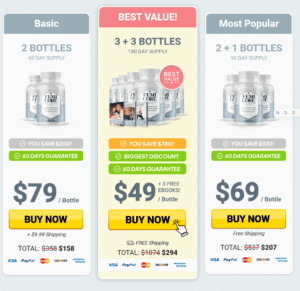
Pricing is one of the main complaints. Based on the offer pages I found, the packages are:
- 2 bottles (60-day supply): $79 per bottle, $158 total, plus $9.99 shipping.
- 3 bottles (90-day supply): $69 per bottle, $207 total, with free US shipping.
- 6 bottles (180-day supply): $49 per bottle, $294 total, with free US shipping and digital bonuses.
Some sources list slightly different figures, and one review places the range at $49 to $89 per bottle, which it calls premium pricing. Treat any number you read in a review as out of date until you see it at checkout.
Two practical points on cost:
- The lowest per-bottle price needs the biggest commitment. The 6-bottle option is $294 up front for a product you haven’t tried. If you’re unsure, start smaller, even though each bottle costs more.
- Check whether you’re buying a one-time purchase or a subscription. One review states that ordering is a one-time purchase with no autoship enrollment. Confirm this on the order page yourself before entering your card details.
The refund policy
The advertised guarantee is 60 days from the purchase date. That is a reasonable window for a product that takes weeks to show any effect. But there is an important condition: the guarantee applies only to purchases made through the official website. If you buy from a reseller or a lookalike site, you may have no refund rights at all.
Before you order, save a screenshot of the guarantee page and check:
- how many days you have, and whether the clock starts on the order date or the delivery date
- whether you must send back the bottles, including empty ones
- who pays for return shipping
- how to request a refund and which email address or phone number to use
- whether the bonuses or shipping fee are refundable
Femicore complaints: the concerns that come up most
I couldn’t find an independent, verified pool of reviews large enough to give honest percentages. One promotional page claims more than 19,000 verified reviews and a 4.9 out of 5 average. Treat figures like that carefully. They come from a page designed to sell; they can’t be checked, and a near-perfect score for any supplement is unusual.
What can be said honestly is which concerns appear repeatedly across reviews and consumer-warning posts.
1. “I didn’t notice a difference.”
Bladder symptoms have many causes: hormones, menopause, weak pelvic-floor muscles, caffeine, medications, infection, diabetes, and more. A supplement that helps with one cause won’t help with another. That is why results vary so much, and why some people see nothing at all.
2. “It takes too long.”
Expectations are often unrealistic. One review advises committing to at least 60 to 90 days of daily use before judging the results. Even one glowing testimonial admits a woman saw no change in the first two weeks and nearly gave up. If a seller promises results in a few days, be skeptical.
3. “It’s expensive.”
At $49 to $79 per bottle, Femicore costs more than many probiotic or cranberry supplements. Higher price doesn’t prove higher quality. Work out the cost per month and compare it with what you’d spend on a standard cranberry capsule, a basic probiotic, and a pelvic-floor program.
4. “I can’t tell what’s actually in it.”
The missing per-ingredient amounts, discussed above, frustrate careful buyers. If a brand won’t tell you how much of each ingredient is in a capsule, you’re taking it on trust.
5. “I couldn’t find the real website.”
This is the biggest practical problem, and it needs its own section.
6. “The marketing is louder than the evidence.”
One critical write-up sums it up fairly: it calls the product legitimate, with an interesting approach, but says the marketing is louder than the science and premium pricing doesn’t guarantee premium results. That is a fair way to read most supplements in this category.
Fake sites, lookalike pages, and “reviews” that aren’t
Because Femicore is sold directly rather than in stores, search results for the name are full of other things. When I searched, I found:
- the brand’s own sales pages in several versions and languages
- affiliate review pages that push you to buy
- press-release-style articles on third-party news sites
- free-site pages (Google Sites, Pixieset, Lovable and similar) built purely for marketing
- unrelated or garbled pages that appear to exist only to catch search traffic
One review warns that a number of similarly named domains exist online, so you should be careful which address you use. Another lists lookalike addresses that scored very low on website trust checkers, and one was tagged suspicious. The brand says it makes its product in an FDA-registered, GMP-certified facility in the United States, and counterfeits won’t meet those standards.
How to protect yourself
- Check the exact web address before entering payment details. Look for small spelling changes, extra words, or unusual endings.
- Be wary of country-specific clones. If a site for another country looks identical to a US one but has a different domain, treat it as unverified.
- Look for company details. A real seller shows a business name, an address, a working email or phone number, and a privacy policy.
- Check how a page handles refunds. Vague or missing terms are a red flag.
- Pay with a credit card or a service with buyer protection, not a bank transfer or a cryptocurrency payment.
- Never share your login details for anything, and ignore pages asking for them.
- Be careful with ad clicks. Social media ads are the most common route to copycat pages. Typing the address yourself is safer.
How to read a Femicore review (or any supplement review)
Look for specific details. “I took it for ten weeks, my night-time trips went from three to one, and I also cut my evening coffee” is more believable than “life-changing, buy now!”
Look for trade-offs. Honest reviews mention what didn’t work, what it cost, and how long it took.
Notice who is paying. Many review sites earn commission when you click a button. That doesn’t make them wrong, but trustworthy sites say so openly. A page full of urgent “limited stock” banners and repeated buy buttons is mostly an advertisement.
Question dramatic claims. Be cautious of anything saying a supplement works “like a medication,” “reverses” a condition, or replaces treatment.
Be careful with “clinical studies.” Some pages describe trials of the product that I couldn’t trace to a published, independent source. One such page admits that the trial was small and that the supplement’s creator funded it, so independent replication is needed. Even that page appears to describe a different formula, which is a good reason to treat it with caution. A study on cranberry or a probiotic strain is not a study of this specific capsule.
Check the date. Prices, ingredients, and policies change, and a review from last year may no longer apply.
Is Femicore legit?
“Legit” can mean three different things, so it helps to separate them.
Is the product real? Yes, there is a real product sold by a real brand through its own website. Several reviewers describe it as a legitimate supplement while still criticizing the claims around it.
Is it safe and well made? The brand states that it is made in the US in a GMP-certified, FDA-registered facility. Remember that “FDA-registered” means the facility has registered with the agency. It does not mean the FDA has approved the product. No third-party testing certificate was visible in the sources I reviewed, so if that matters to you, ask the seller for one.
Do the claims hold up? This is the weak point. The individual ingredients have some research behind them, but that research is on the ingredients in general, not on this exact blend, at these undisclosed doses.
So the fairest verdict is “a real product, with marketing that goes further than the evidence.”
Who may want to think twice?
Speak to a doctor or pharmacist before taking Femicore, or any similar supplement, if you:
- are pregnant or breastfeeding
- are under 18
- take prescription medication, particularly blood thinners, diabetes drugs, or anything for blood pressure, since some herbal ingredients can interact
- have kidney disease, liver disease, or diabetes
- get frequent urinary infections
- have a weakened immune system, since probiotics are not always suitable
- are allergic to any listed ingredient
- are scheduled for surgery soon
The brand’s own materials say the same thing for pregnant or nursing women, people under 18, and anyone with a medical condition.
When it isn’t a supplement problem
Please book a medical appointment promptly, and don’t wait on a supplement, if you notice:
- pain or burning when you urinate
- blood in your urine, or cloudy or strong-smelling urine that doesn’t clear up
- fever, chills, nausea, or pain in your back or side
- a sudden change in how often you need to go
- leaking that is getting worse, or that began after surgery, childbirth, or a new medication
- symptoms that keep returning
These can be signs of a urinary tract infection, a kidney problem, a hormone change, or a pelvic-floor problem. Each of those has proper treatment, and delaying it can cause harm. Many bladder problems also respond well to approaches that don’t involve supplements at all, such as pelvic-floor physiotherapy, bladder training and medication changes.
Things that help your bladder, whatever you take
These habits are well established and cost nothing:
- Drink steadily through the day. Too little water makes urine more concentrated and irritating, and too much at once can increase urgency.
- Cut back on likely irritants if you find they affect you, such as caffeine, alcohol, carbonated drinks and artificial sweeteners.
- Don’t rush your bladder emptying, and don’t hold urine for long periods.
- Practice pelvic-floor exercises. A pelvic-floor physiotherapist can teach you correctly, which matters because many people do them wrongly.
- Urinate after sex and wipe front to back, which reduces infection risk.
- Manage constipation. A full bowel puts pressure on the bladder.
- Look at your medications. Some diuretics and other drugs can increase urgency, so ask your doctor before changing anything.
If you try a supplement alongside these habits, you’ll be better placed to judge whether it added anything.
How does Femicore compare with other options?
Femicore is often mentioned in the same searches as products like Uqora or AZO, but they aren’t direct equivalents. Some focus on infection prevention, some on symptom relief, and some on general bladder comfort. When you compare any two, look at:
- Whether doses are listed. Transparent labels are easier to evaluate.
- Price per month. Compare the real cost, not the headline discount.
- Evidence for the specific ingredients at the stated dose.
- Third-party testing. A certificate from an independent lab is a good sign.
- Refund terms. A real guarantee is the best protection you have.
- How honest the claims are. The best brands use cautious language, such as “supports.”
Cheaper alternatives include a plain cranberry extract, a single well-studied probiotic, or a pelvic-floor program, depending on what your symptoms are. None of those is guaranteed to work either, but you’ll know exactly what you’re paying for
Frequently asked questions
Is Femicore safe?
Most healthy adults tolerate supplements like this well, but safety depends on your health, your medications and the exact formula. Read the label and speak to a clinician if you’re unsure.
Does Femicore work?
Results vary widely. The ingredients have some supporting research, but there’s no independent evidence I could find for this exact blend, and no supplement can guarantee an outcome.
How long until I notice anything?
Reviews suggest at least 60 to 90 days of daily use. If you have troubling symptoms, don’t wait that long before seeing a doctor.
Can it replace antibiotics or prescription medication?
No. Only a clinician can diagnose and treat an infection or a medical condition.
Is Femicore sold on Amazon or in stores?
The brand says it is available only through its own website. Anything sold elsewhere may be a reseller or a counterfeit, and may not be covered by the refund guarantee.
What are the side effects?
Possible effects include stomach upset, gas, or an allergic reaction. Stop taking it and get medical advice if you have a reaction.
How do I get a refund?
Follow the process on the seller’s refund page, contact them in writing, and keep your order confirmation. If you paid by card and get no reply, you can raise a dispute with your card provider.
Is Femicore a scam?
The product exists, and the seller advertises a refund policy, so it isn’t a pure fake. The concerns are the strength of the marketing claims, the undisclosed doses, the price, and the many lookalike sites.
Our verdict
Femicore may be worth a try if you want a daily bladder-support supplement, you have realistic expectations and you can afford a 60 to 90 day trial. The complaints are consistent and fair: results vary, it costs a lot, it takes patience, the doses aren’t published, and the web is full of lookalike pages.
It isn’t a cure and it isn’t a replacement for medical care. Buy only from the genuine seller, read the refund terms before you pay, track your symptoms honestly, and see a doctor if things don’t improve or get worse.
Disclaimer: This article is for general information only and is not medical advice. Statements about supplements have not been evaluated by the FDA. This product is not intended to diagnose, treat, cure, or prevent any disease. Always consult a qualified healthcare professional about your health.

USA Buyers Guide is your trusted destination for informative product reviews, supplement insights, health and wellness information, and digital product guides. We help readers explore product features, compare options, and make more informed buying decisions.